
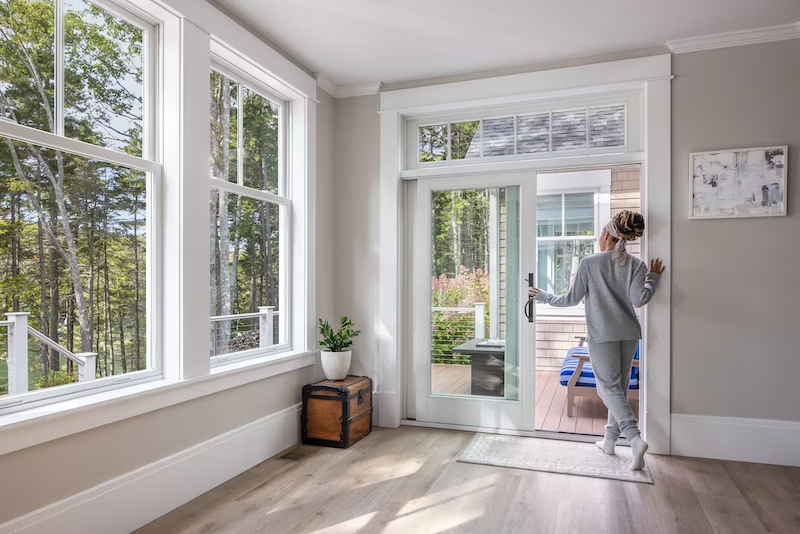
Standing in front of your living room window on a freezing February morning, you notice frost forming on the inside of the glass. Or maybe it’s July, and despite your air conditioner running constantly, the room feels unbearable. You’ve been wondering: is it finally time for window replacement?
Here’s what most Chicago homeowners don’t realize: by the time window problems become obvious, you’ve already wasted thousands of dollars in energy costs and potentially compromised your home’s structure. That condensation isn’t just annoying—it’s creating conditions for mold growth. Those drafts aren’t just uncomfortable—they’re costing you $100-$200 per window annually in wasted energy.
The question isn’t really “when should I replace my windows?” It’s “can I afford NOT to?”
This article cuts through the confusion surrounding window replacement decisions with objective criteria. If you are just starting your research, you may want to bookmark our comprehensive window replacement guide for Chicago for a broader overview. Here, we will help you separate “maybe someday” from “schedule it now,” understand the true return on investment for Chicago homes, and learn how to avoid the costly mistake of replacing windows too early or waiting too long.
The Hard Truth About Window Lifespan in Chicago
Most national window guides, including generic National Association of Home Builders window lifespan research, cite lifespans of 20-25 years. That’s technically accurate for temperate climates like California. Chicago’s reality is harsher.
Why Chicago Windows Age Faster
Our extreme climate accelerates window degradation through multiple mechanisms. Temperature cycling is brutal—Chicago experiences 60-80°F temperature swings within 24-hour periods during spring and fall. Windows expand and contract constantly, stressing seals, gaskets, and frame joints. Over 20 years, this cycling equals 40+ years in milder climates.
Freeze-thaw damage compounds the problem. Water infiltration is inevitable over time. When moisture freezes in Chicago’s sub-zero winters, it expands with tremendous force, cracking seals, separating glazing, and deteriorating frames. Each winter inflicts cumulative damage that accelerates window replacement needs.
UV degradation also plays a role. Despite our reputation for gray weather, Chicago receives substantial UV exposure, particularly in summer. UV radiation breaks down window seals, weatherstripping, and glazing compounds faster than in cloudier regions.
Realistic Chicago Window Lifespans
Single-pane windows from pre-1980 have a 30-50 year structural lifespan but are obsolete from day one regarding efficiency. Verdict: replace immediately regardless of age.
Early double-pane windows from 1980-2000 had an expected lifespan of 15-20 years. Most now have failed seals or significant performance degradation. Verdict: overdue for window replacement.
Quality double pane window replacement from 2000-2010 has an expected lifespan of 20-25 years and is currently approaching end of effective life. Verdict: evaluate carefully; replacement often justified.
Modern windows from 2010+ have expected lifespans of 25-30+ years and should perform well with proper maintenance. Verdict: monitor but no immediate action needed.
The critical insight: age alone doesn’t determine replacement timing—performance degradation does. A well-maintained 15-year-old window might outperform a poorly installed 5-year-old window.
Clear Signs You Need Window Replacement NOW
Stop guessing. These objective indicators tell you exactly when window replacement becomes necessary.
Category 1: Structural Failures (Replace Immediately)
Broken or cracked glass indicates structural problems or impact damage that often extends to frames and seals. Modern insulated glass units cannot be “repaired”—they require complete replacement.
Broken seals between panes create a foggy appearance or condensation that never clears. This seal failure means the insulating gas has escaped and moisture has entered. The window has lost 30-50% of its insulating value. Repair is impossible; complete double pane window replacement is required. In Chicago, seal failures accelerate rapidly once started—one failed window often indicates others will fail soon.
Rotted or deteriorated frames are testable: press a screwdriver into wooden frames. If it sinks into soft, spongy wood, you have active rot. Vinyl and aluminum frames show deterioration through cracking, warping, or separation at joints. These structural issues compromise the entire window system and allow water infiltration damaging walls and structure. Replacement urgency is high—rotted frames indicate water damage spreading to surrounding wall structures.
Category 2: Performance Degradation (Replace Soon)
Persistent drafts despite weatherstripping indicate serious problems. Test on a windy day by holding a lit incense stick or candle near closed window edges. Smoke deflection indicates air leakage. New weatherstripping might temporarily reduce drafts, but if windows still leak after weatherstripping replacement, the problem is structural. Frame warping, poor original installation, or settling has created gaps that weatherstripping cannot seal. In Chicago, each drafty window costs $50-$150 annually in wasted energy. A house with 15 drafty windows wastes $750-$2,250 yearly.
Difficult operation means windows requiring excessive force to open/close or that won’t lock properly have warped frames or failed mechanisms. Beyond inconvenience, this creates security vulnerabilities and prevents emergency egress. Building codes require bedrooms to have operable egress windows—windows that won’t open fully create life-safety hazards.
Condensation issues vary by location. Interior condensation forms on the room-side glass surface, especially lower corners, indicating insufficient insulation and thermal bridging. While not always requiring immediate replacement, it signals poor performance and creates mold-growth conditions. Between-pane condensation requires immediate window replacement. Exterior condensation actually indicates good insulation and is normal, requiring no action.
Category 3: Economic Signals (Evaluate Replacement)
Constantly rising energy bills deserve attention. Track heating and cooling costs year-over-year accounting for rate changes and usage patterns. If energy costs increase 15%+ without corresponding rate hikes or usage changes, failing windows are likely culprits. Request energy usage data from utility companies for the past 3-5 years and compare with neighbors in similar homes. Significantly higher usage often points to window inefficiency.
Uneven room temperatures indicate rooms consistently colder in winter or hotter in summer than the rest of your home, suggesting localized heat loss/gain. Windows are the most common cause. This performance issue degrades comfort and forces HVAC systems to work harder, accelerating the need for window replacement.
Is It Worth Replacing 20-Year-Old Windows?
This question dominates homeowner discussions. The answer isn’t simple, but it IS answerable with the right analysis.
The Case FOR Replacing 20-Year-Old Windows
Technology advancement is significant. Windows from 2006 (20 years old) predate major efficiency improvements found in modern energy-efficient window options. Low-E coatings were inferior to modern multi-layer coatings, argon was standard but superior krypton was rare and expensive, metal spacers created thermal bridging while warm-edge spacers weren’t common, and modern multi-chamber vinyl designs significantly outperform 2006 technology. To see how these specs compare, you can review the ENERGY STAR’s window performance ratings guide.
Real-world impact: modern windows are 25-35% more efficient than windows from 2006, even if the older windows were “high-quality” for their era.
Seal failure probability is high. Windows from 2006 are at or past typical seal lifespan. Even if seals haven’t visibly failed yet, degradation has begun. Microscopic seal failures that don’t yet show condensation still allow gas loss and moisture infiltration. Statistical reality: 30-40% of windows manufactured in 2006 will have visible seal failures by 2026. Another 30-40% will have performance degradation without visible signs, making window replacement near me searches increasingly common.
Energy Cost Recovery Analysis
Let’s calculate the 20-year-old window replacement decision using data similar to the Department of Energy cost recovery analysis:
Assumptions: home has 15 windows, current windows are 2006 double-pane with U-factor 0.45, new windows are modern double-pane Low-E argon with U-factor 0.28, Chicago heating/cooling costs are $2,400 annually with windows accounting for 30% of energy loss at $720 annually, and improvement is 35% reduction equaling $252 annual savings.
Replacement cost is $9,000 (15 windows × $600 average) with annual savings of $252, giving a simple payback of 36 years (seemingly too long). But this calculation is incomplete.
Additional factors include energy costs typically increasing 3-4% annually with inflation and rate hikes, old windows continuing to degrade and widening the efficiency gap, repair costs for 20-year-old windows of $50-150 per window over 10 years, and property value increase of $6,000-8,000 (70% cost recovery) based on the annual Remodeling Magazine Cost vs. Value Report.
Adjusted analysis shows present value of energy savings over 15 years (assuming 3.5% annual energy cost increase) at $4,500, avoided repair costs of $1,500, and property value increase of $7,000, creating total value of $13,000.
Net benefit: $13,000 value – $9,000 cost = **$4,000 net positive value**. Conclusion: yes, replacing 20-year-old windows IS worth it for most Chicago homeowners when analyzing total value, not just energy savings alone.
The Case AGAINST Replacing 20-Year-Old Windows
Limited scenarios where waiting makes sense include short-term ownership (selling within 1-2 years where minor weatherstripping repairs might suffice unless windows are obviously deficient), major renovations planned (if planning gut renovation or significant exterior work within 3-5 years, coordinate window replacement with that project to avoid redundant work), financial constraints (if budget is extremely tight and windows are functional with no structural issues, temporary weatherization might extend usability 2-3 years), and historic preservation (if you own historic property with original windows in good structural condition, restoration might be preferred for authenticity).
Understanding the 25% Glazing Rule
The 25% glazing rule is an architectural guideline suggesting window area should not exceed 25% of floor area in energy-efficient design. This prevents excessive heat loss or gain through windows.
However, in Chicago’s climate with modern energy-efficient windows featuring Low-E coatings and triple-pane construction, this rule is less restrictive. Today’s high-performance windows allow larger glass areas while maintaining excellent energy efficiency, especially when strategically positioned for optimal natural light and passive solar gain.
For wooden window replacement chicago properties, particularly historic homes, this rule helps balance preservation aesthetics with modern performance. The key is choosing the best window replacement company that understands both historic requirements and modern efficiency standards.
Common Window Replacement Mistakes to Avoid
Many homeowners make costly errors during the decision process.
Mistake 1: Waiting Too Long
Delaying window replacement when clear signs exist wastes money on energy bills, risks structural damage from moisture infiltration, decreases comfort and quality of life, and reduces home value. The “I’ll wait one more year” mentality often costs more than immediate action would.
Mistake 2: DIY Installation Attempts
Improper installation causes air leaks that negate energy efficiency, water infiltration leading to structural damage, voided manufacturer warranties, windows that don’t operate properly, and reduced lifespan. Using a professional window installation service isn’t where you should cut costs—installation quality matters as much as window quality.
Mistake 3: Choosing Price Over Quality
Accepting the lowest bid without investigating quality, warranties, or contractor reputation usually means lower-grade materials that fail prematurely, shortcuts in weatherization and air sealing, no warranty support when problems arise, and complete replacement needed in 5-10 years instead of 20-30 years. Choose the best value, not the lowest price.
Mistake 4: Ignoring Crawl Space and Basement Windows
Many homeowners focus on main living areas and forget crawl space window replacement. These often-neglected windows contribute significantly to energy loss and moisture problems. Include them in your overall window replacement strategy for complete home efficiency.
Frequently Asked Questions
Is it worth replacing 20 year old windows?
Yes, replacing 20-year-old windows is typically worth the investment in Chicago. Windows from the early 2000s lack modern energy efficiency features like Low-E coatings, advanced gas fills, and improved weatherstripping. Chicago homeowners can expect 25-35% energy savings with new windows, recovering replacement costs through lower utility bills in 7-10 years. Additionally, 20-year-old windows often show performance degradation including seal failures, drafts, and operational issues that impact comfort and home value significantly.
What is the 25 glazing rule?
The 25% glazing rule is an architectural guideline suggesting that window area should not exceed 25% of floor area in energy-efficient design. This prevents excessive heat loss or gain through windows. However, in Chicago’s climate with modern energy-efficient windows featuring Low-E coatings and triple-pane construction, this rule is less restrictive. Today’s high-performance windows allow larger glass areas while maintaining excellent energy efficiency, especially when strategically positioned for optimal natural light and passive solar gain in your home.
How much is window replacement?
Window replacement costs typically range from $450 to $1,200 per window in Chicago, depending on size, material, and features. Vinyl windows average $450-$650, fiberglass runs $700-$950, and wood-clad windows cost $800-$1,200. Complete home projects for 15-20 windows range from $8,500-$15,000. Costs include materials, professional installation, permits, and disposal. Premium energy-efficient features add 15-25% but deliver superior long-term value through energy savings and improved comfort in Chicago’s challenging climate.
Should I repair or replace my windows?
Repair if windows are less than 10 years old with minor issues like broken hardware, damaged weatherstripping, or single cracked pane. Replace if windows have structural damage, failed seals between panes, significant drafts, are 20+ years old, or show multiple performance issues. In Chicago’s climate, replacement often provides better long-term value than repeated repairs on aging windows.
How do I find the best window replacement company?
Look for local Chicago companies with 5+ years experience, proper licensing and insurance, manufacturer certifications, strong Better Business Bureau ratings, verified customer reviews, written warranties on materials and labor, transparent itemized pricing, and willingness to provide local references. Avoid high-pressure sales tactics and companies requesting full payment upfront.
Can I replace windows in winter?
Yes, professional contractors can install windows year-round in Chicago with proper techniques including installing one window at a time to minimize heat loss, using cold-weather sealants designed for low temperatures, scheduling during milder days above 20°F, and providing heated enclosures for exterior work. However, spring and fall typically offer optimal conditions for window replacement.
Do new windows really save money?
Yes, quality window replacement delivers measurable energy savings. Chicago homeowners typically see 25-35% reduction in heating and cooling costs related to windows, payback periods of 7-10 years through energy savings alone, and additional value from improved comfort, reduced noise, and increased home resale value. The key is choosing energy-efficient windows properly installed by qualified professionals.
Ready to Make Your Window Replacement Decision?
You now have objective criteria to determine when window replacement makes sense for your Chicago home. From understanding the true ROI to recognizing warning signs and avoiding common mistakes, you’re equipped to make confident decisions.
Schedule a free window assessment today. We’ll inspect your windows, answer your specific questions, and provide expert recommendations tailored to your home and budget—with complete transparency and zero pressure.